Placement
Feeders and Windows
Window collisions kill more feeder birds than cats, hawks and disease combined at most houses. Distance is the lever you control, and the safe distances are not the ones people guess.
The short answer
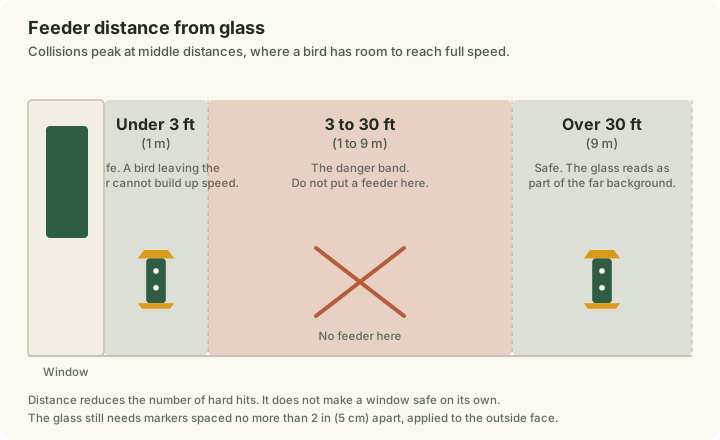
- Put feeders either under 3 feet (1 m) from the glass or more than 30 feet (9 m) away. Both extremes are safe for different reasons.
- The dangerous band is roughly 5 to 25 feet (1.5 to 7.5 m), where a flushed bird reaches full speed before it reaches the window.
- Impact energy rises with the square of speed, so a bird traveling twice as fast hits four times as hard. Short runways are the whole point.
- Placement reduces strikes; it does not stop them. Only treating the outside surface of the glass changes what the bird sees.
- Markers work when spaced no more than about 2 inches (5 cm) apart. A single decal in the middle of a large pane does almost nothing.
A bird feeder belongs either within 3 feet (1 m) of your window or more than 30 feet (9 m) from it. Anywhere in between and you have built a runway.
The rule sounds backwards the first time you hear it. Putting the feeder right against the glass feels like inviting collisions, and moving it to the middle of the lawn feels safer. The physics says otherwise, and it comes down to how much distance a startled bird has to accelerate before it meets the pane.
Widely cited estimates put annual bird deaths from building collisions in the United States in the hundreds of millions, with houses and low-rise buildings accounting for a large share of the total because there are so many of them. What follows is why the two safe zones work, why the middle is worse than either, and why feeder placement alone will not finish the job.
Why birds hit glass at all#
Birds do not perceive glass as a solid object. They read what the glass shows them.
Reflection is the common case at a house. In daylight the outside is far brighter than the inside, so a window works as a mirror. It shows the birch tree, the hedge, the open sky. A bird flying toward that image is flying toward what it believes is cover, which is exactly what a bird flushed by a hawk is trying to reach.
Pass-through is the other case. Where two windows face each other across a room, or a glass door sits at the end of a bright hallway, the bird sees an unbroken route to the vegetation on the far side. Corner windows in modern houses are especially bad for this.
Neither problem is affected by whether you feed birds. Feeding simply increases the number of birds near the house, and it adds the one behavior that turns a reflection into a collision: the sudden, panicked flush.
The under 3 foot zone#
A feeder mounted on or very near the glass is safe because it removes the runway.
A songbird leaving a perch accelerates over several feet, and typical small-bird flight speeds run somewhere around 20 to 30 mph (32 to 48 km/h). Give a chickadee 2 feet (0.6 m) and it cannot get near that. It leaves the feeder, meets the pane at little more than a hop, and flies off.
That is why suction-cup window feeders have a better safety record than feeders on the lawn 15 feet out, and why a homemade window feeder is a reasonable choice for anyone in an apartment or on a balcony with nowhere far to put anything.
The same logic applies to a pole feeder set 2 to 3 feet (0.6 to 1 m) from the wall. Keep the birds inside the acceleration distance and impacts stay at bump speed.
The rule in one line
Close enough that a bird cannot get up to speed, or far enough that your window is not the obvious escape route. Anything in between gives the bird both a clear reflection and room to reach it fast.
The over 30 foot zone#
Distance works differently. At 30 feet (9 m) or more, two things change.
The reflection stops dominating the bird's field of view. Up close, a large pane fills the visual field with mirrored habitat. From across a yard the house is one element among many, and the frame, siding and roofline are visible cues that something solid is there.
And a bird flushed at 30 feet is much less likely to choose the house as its escape direction, because there is usually real cover closer. That is one of the reasons the 10 to 12 foot cover distance matters so much: birds flee toward the nearest shrub, and if a shrub is nearer than the house, the shrub wins.
Why the middle distances are the worst#
Between roughly 5 and 25 feet (1.5 and 7.5 m), everything lines up badly.
The bird has enough space to reach cruising speed. The window still fills a large part of its forward view, showing sky or vegetation. And if the feeder is a bird's only nearby resource, the house may genuinely be the closest thing that looks like cover.
The energy arithmetic is unforgiving. Kinetic energy scales with the square of velocity, so a bird at 20 mph arrives with four times the energy of one at 10 mph. Skull and spine injuries in birds are not a gradual scale: below a threshold most birds bounce off, above it many die, and a surprising number of the ones that fly away afterward die later of internal bleeding. That is why "it flew off, so it was fine" is unreliable.
| Distance from glass | What happens on a flush | Verdict |
|---|---|---|
| Under 3 ft (1 m) | No room to accelerate; low-speed bump | Safe |
| 3 to 5 ft (1 to 1.5 m) | Partial acceleration; injuries possible | Marginal, avoid |
| 5 to 25 ft (1.5 to 7.5 m) | Full flight speed into a mirrored pane | Most dangerous |
| 25 to 30 ft (7.5 to 9 m) | Improving, but still a plausible escape line | Marginal |
| Over 30 ft (9 m) | House is one object among many; other cover is nearer | Safe |
Bird baths and shrubs count too
Anything that concentrates birds sets the same trap. A bird bath or a berry shrub 15 feet from a picture window produces strikes just as reliably as a feeder does, and American robins and waxwings are frequent casualties at fruiting plants near glass.
Which windows cause the most trouble#
Not all glass is equally dangerous. Look for these before you decide where the feeder goes.
- Large unbroken panes, especially picture windows and sliding doors, where nothing breaks up the reflection.
- Corner glass, where two windows meet and the pass-through illusion is strongest.
- Windows that reflect vegetation rather than sky. Check from outside at bird height, not from indoors.
- Glass railings and glass porch enclosures, which are invisible from every angle.
- Windows on the sheltered side of the house, where birds go during storms.
Walk outside on a bright day, crouch to about 4 feet (1.2 m), and look at each window from the direction the feeder faces. If you see trees and sky, so does the bird.
Placement is only part of the fix#
This is the honest part. Moving a feeder changes where birds congregate. It does not change what your window looks like from outside, and birds pass through yards for reasons that have nothing to do with feeders.
If your house has had strikes, treat the glass:
- Apply patterns to the outside surface. Anything applied inside is behind the reflection and largely invisible to the bird.
- Space markers no more than about 2 inches (5 cm) apart in both directions. Birds attempt to fly through gaps, and a single decal simply gets flown around.
- External screens, netting or cords hung a few inches off the glass are the most effective options, because they both break the reflection and cushion any impact.
- Turn off unnecessary interior lights at night during spring and fall migration.
Full treatment options are covered in preventing window strikes, and it belongs on any serious bird-friendly yard checklist.
Diagnose before you spend
Note where you find casualties or feather smudges on the glass, and on which side of the house. Most homes have one or two problem panes rather than a general problem. Treating two windows properly beats treating eight badly.
Moving a feeder that is in the wrong zone#
If your feeder currently sits 12 feet (3.5 m) from a picture window, you have two options and one non-option.
Bring it in close, to within 3 feet (1 m), or push it out past 30 feet (9 m). Splitting the difference to 20 feet is the non-option, since that is still in the danger band.
Move it in stages of a few feet every couple of days rather than all at once, so the birds keep track of it. That method, and how long to expect a lull afterward, is in moving a feeder without losing the birds. If a bird does strike and survives, handle it as described in there is a sick bird at my feeder: quiet, dark, contained, and hands off.
Frequently asked questions#
How far should a bird feeder be from a window?
Either less than 3 feet (1 m) or more than 30 feet (9 m). Within 3 feet a startled bird cannot build up enough speed to injure itself. Beyond 30 feet, birds are less likely to flush directly into the house and have room to recognize the reflection. The distances in between are the ones associated with the most collisions.
Do window feeders cause bird strikes?
No, and suction-cup window feeders generally reduce them. A bird leaving a feeder stuck to the glass has essentially no runway, so a startled bird bumps the pane at low speed instead of hitting it at full flight speed. The trade-off is that the feeder itself needs frequent cleaning.
Why do birds fly into windows?
Two reasons. Reflection: the glass mirrors trees, shrubs and sky, so the bird sees habitat rather than a barrier. Pass-through: with windows on opposite walls, or a glass door beside a hallway, the bird sees an unobstructed route to the far side. Both are worst in daylight, when the outside is brighter than the inside.
Do window decals stop bird strikes?
Only if there are enough of them. A single hawk silhouette leaves the rest of the pane looking like open sky, and birds simply fly around it. Current guidance from bird conservation groups is closely spaced markers, no more than about 2 inches (5 cm) apart, applied to the outside of the glass.
What should I do if a bird hits my window?
If it flies off, leave it. If it is stunned, place it in a ventilated cardboard box in a dark, quiet, warm place away from pets, and check after an hour. Do not offer food or water. Many birds recover and can be released outdoors, but internal injuries are common, so contact a licensed wildlife rehabilitator if it cannot fly after a couple of hours.