Identification
Identify a Feeder Bird
Color is the clue everyone reaches for first and the one most likely to be wrong. Work through size, shape, bill and behavior first, and most feeder birds name themselves.
The short answer
- Judge size against a bird you already know, not in inches: chickadee, house sparrow, cardinal, robin and crow cover almost every feeder visitor.
- Bill shape tells you the family before color tells you anything: a short cone eats seed, a chisel drills wood, a thin spike eats insects, a needle drinks nectar.
- Where the color sits matters far more than which color it is, because that boundary is what separates a house finch from a purple finch and a red-bellied woodpecker from a red-headed.
- Behavior at the feeder is close to diagnostic on its own: only nuthatches walk headfirst down a trunk, and only chickadees and titmice take one seed and leave.
- Season and region cut the candidate list roughly in half before you look at the bird at all.
- Some pairs genuinely cannot be separated at feeder range, and the right answer in those cases is to log the pair rather than to guess.
You get about four seconds. The bird drops onto the feeder, takes a seed, and is gone into the hedge before you have found your glasses. Whatever you noticed in those four seconds is all the evidence you are ever going to have, so it is worth deciding in advance which four seconds of detail actually narrow the list.
Most people spend them on color, and color is the least reliable thing on a bird. It shifts with sex, age, season, molt, feather wear and the angle of the light. An American goldfinch in January is not yellow. A male house finch can be red, orange or yellow depending on what he was eating while he grew those feathers. Blue is not even a pigment. Size, proportion, bill shape and behavior change far less, and all four are readable at a glance once you know what you are looking at.
What follows is a repeatable method: five questions, asked in a fixed order, that take a continental list of several hundred species down to two or three candidates. Under the method sits a directory of guides arranged the way people actually search, by color and by family, and at the bottom an honest list of the pairs that cannot be separated at feeder range no matter how good your binoculars are.
The five questions, in order#
The order is the whole trick. Each question is more reliable than the one below it, so you spend your best observation on the most useful clue and treat color as a tiebreaker rather than an opening bid.
- How big is it, compared with a bird I already know?
- What shape is the bill, and what does that shape do for a living?
- Where on the bird is the color, and where does it stop?
- What is it doing: clinging, hanging, hopping on the ground, hovering, walking?
- What month is it, and what part of the continent am I in?
If you answer only the first, second and fifth, you will still get most feeder birds to family and many of them to species. If you answer only the third, you will spend a lot of winters convinced your goldfinches have left. Every guide in this section is built on the same five questions, so once you have the habit it transfers to birds you have never seen before.
Question 1: how big is it, next to a bird you already know#
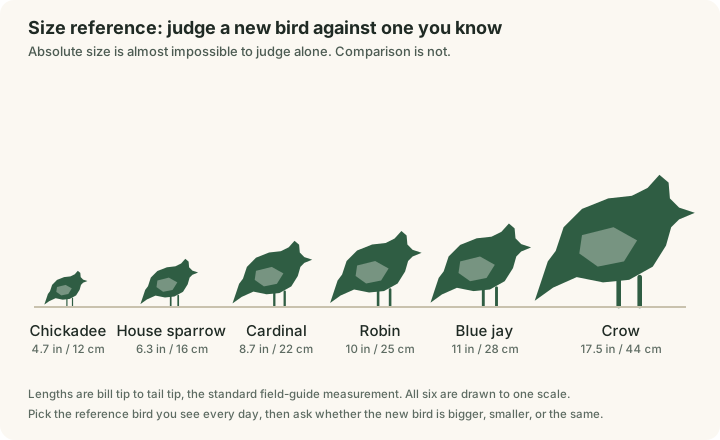
Nobody estimates inches accurately on a moving bird at 30 feet (9 m). What people do accurately is compare. Learn five reference birds by size and you will never need a ruler again, because every feeder bird in North America slots into one of the gaps between them.
| Reference bird | Typical length | What it anchors |
|---|---|---|
| Black-capped chickadee | 4.7 in (12 cm) | The tiny class: goldfinches, pine siskins, warblers, wrens, kinglets, bushtits, nuthatches |
| House sparrow | 6.3 in (16 cm) | The small-brown-bird class: most sparrows, house and purple finches, juncos, buntings |
| Northern cardinal | 8.7 in (22 cm) | The medium class: red-winged blackbird, cowbird, orioles, red-bellied woodpecker |
| American robin | 10 in (25 cm) | The mid-size yardstick: starling (a bit smaller), hairy woodpecker, northern flicker (a bit bigger) |
| Blue jay | 11 in (28 cm) | Chunky, crested, long-tailed birds: jays, Steller's jay, scrub-jay |
| Mourning dove | 12 in (30 cm) | Long-tailed birds where half the length is tail: doves, grackles |
| Common grackle | 12.5 in (32 cm) | The big blackbird class, keel-tailed and yellow-eyed |
| American crow | 17.5 in (44 cm) | The large class: pileated woodpecker, fish crow (smaller), common raven (much bigger) |
Lengths here are the usual field-guide figures, measured from bill tip to tail tip on a laid-out bird, so they overstate how big a bird looks when it is perched and hunched. Treat them as relative, not absolute. What you want out of this table is the sentence: bigger than a chickadee, smaller than a house sparrow. That alone rules out most of the continent.
Use the feeder as your ruler
Your feeder does not move and does not molt. Measure the perch spacing, the port diameter and the height of the seed tube once, write it down, and from then on every bird that lands is standing next to a known scale. A bird that spans two perches is not the same bird as one that fits between them.
Question 2: what shape is the bill#
The bill is a tool, and the tool tells you the trade. This is the single most transferable skill in bird identification, because bill shape is a family trait and it does not change with sex, season or light. It also tells you immediately whether the bird is at your feeder for seed at all, or whether it is there for suet, insects or nectar.
| Bill shape | Trade | Feeder birds with it | What it takes |
|---|---|---|---|
| Short, deep cone | Small seed cracker | House finch, goldfinches, song sparrow, junco, siskin | Sunflower, nyjer, millet |
| Heavy, blunt cone | Big seed cracker | Northern cardinal, evening grosbeak, pine grosbeak, rose-breasted grosbeak | Striped and black oil sunflower, safflower |
| Straight chisel | Woodpecker | Downy, hairy, red-bellied, red-headed | Suet, peanuts, sunflower |
| Thin, straight spike | Insect prober and bark worker | Nuthatches, brown creeper, bluebirds, starling | Suet, mealworms, peanut bits |
| Fine, slightly downcurved point | Gleaner | Carolina wren, house wren, yellow-rumped warbler | Suet, mealworms, rarely seed |
| Long, sharp dagger | Prober and gaper | Baltimore oriole, orchard oriole, grackles, red-winged blackbird | Fruit, jelly, nectar, grain |
| Needle | Nectar feeder | Ruby-throated, Anna's, rufous hummingbird | Nectar, small insects |
| Small, soft, pigeon bill | Ground gleaner | Mourning dove, Eurasian collared-dove | Millet, cracked corn, on a tray or the ground |
Compare bill to head, never bill to your idea of a bill. The classic case is the downy woodpecker against the hairy woodpecker: the downy's bill is roughly a third of the width of its head and looks like an afterthought, while the hairy's is nearly as long as the head is wide and looks like a spike driven through the front of the bird. That ratio holds at any distance and in any light, which is exactly what a good field mark should do.
Question 3: where is the color, not which color is it#
This is the question that separates people who identify birds from people who guess at them. Nearly every color-based identification in this section turns on a boundary: where the red stops, whether the yellow reaches the undertail, whether the streaking is on the flanks or only on the breast.
A male house finch has red on the forehead, eyebrow, throat and upper breast, and brown everywhere behind it, with heavy blurry streaks down the flanks. A male purple finch is washed in raspberry over the head, back and breast with clean flanks. Both are red birds with cone bills at a tube feeder. The only difference that matters is where the color stops. Same with woodpeckers: a red-bellied woodpecker has a red stripe over the crown and nape and a gray face, while a red-headed woodpecker has a hood of solid red down to the shoulders with no gray anywhere in it.
Boundaries beat colors
Write down where the color starts and stops before you write down what color it was. A note that says red on the throat, brown on the cap identifies a bird. A note that says red bird does not.
Question 4: what is it doing#
Behavior is the clue that survives bad light, backlighting and a dirty window. After a week of watching one feeder you will start naming birds by how they move before you have seen a single field mark, and you will be right more often than you were when you were squinting at plumage.
| What you are watching | Almost certainly | Why it happens |
|---|---|---|
| Takes one seed and flies to a branch to hammer it | Chickadee, titmouse or nuthatch | They wedge and chisel seeds open rather than shelling them in the bill |
| Walks headfirst down a tree trunk | Nuthatch | The only North American feeder group that routinely goes down a trunk head first |
| Braced against a vertical surface with the tail pressed in | Woodpecker | Stiff tail feathers work as a third leg, which is why they hate swinging feeders |
| Hangs upside down under a feeder or a cone | Goldfinch, pine siskin, chickadee | Small acrobatic finches and tits feed at any angle |
| Sits at one port and shells seed for minutes | House finch, goldfinch, siskin | Flocking finches feed in place and hold the port |
| Hops on the ground and kicks backward with both feet | Towhee, fox sparrow, white-throated sparrow | The double-scratch is a leaf-litter feeding move |
| Walks rather than hops | Starling, grackle, cowbird, blackbird, dove | Gait alone separates the icterids and starlings from sparrows and finches |
| Hovers in front of the feeder | Hummingbird, or a chickadee snatching a seed on the wing | Sustained hovering is a hummingbird; a half-second hover is not |
| Everything leaves the moment it lands | Blue jay, grackle, or an accipiter hawk | Check whether the other birds came back in 30 seconds or in 20 minutes |
Behavior also tells you what to put out. A bird that braces on its tail wants a suet feeder mounted against something solid. A bird that scratches on the ground wants seed on a tray or on the ground rather than in a tube, which is the reasoning behind ground feeders and platform feeders.
Question 5: what month is it and where are you#
Roughly half of the birds in any North American field guide never occur in your county, and a good share of the rest are only there for part of the year. Checking range and season before you check plumage is not cheating, it is what experienced birders do first. A streaky rusty-capped sparrow at an Ohio feeder in January is an American tree sparrow, and the same bird in June is a chipping sparrow, and no amount of staring at the breast spot beats knowing the date.
Season also changes the bird itself. Goldfinches molt out of yellow entirely and spend the winter drab olive-brown. Starlings go from glossy black with a yellow bill in spring to heavily white-spotted with a dark bill in fall. White-throated and white-crowned sparrows arrive in immature plumage with tan and brown head stripes instead of crisp black and white. The regional guides tell you who is possible where you are, the feeding calendar tells you when they turn up, and the feeder bird finder does both at once if you would rather answer questions than read.
Start with a color#
Color is a bad first field mark and an excellent search term, which is why these guides exist. Each one opens with the birds you are most likely to be looking at, then works through the separation problems in table form.
| Guide | Covers | The hard part |
|---|---|---|
| Small brown birds | Sparrows, female finches, wrens, female blackbirds, siskins | Almost all of them are streaky and brown, so the work is in face pattern and breast markings |
| Red birds | Cardinals, house and purple finch, redpolls, tanagers, red-headed woodpeckers | Where the red is: hood, bib, cap, shoulder patch or belly |
| Yellow birds | Goldfinches, siskins, evening grosbeak, orioles, warblers | Winter goldfinches, which are not yellow and are the reason people think their finches left |
| Blue birds | Jays, bluebirds, buntings, blue grosbeak, tree swallow | Blue is structural, not a pigment, so the same bird looks black in the wrong light |
| Black birds | Grackles, starlings, cowbirds, blackbirds, crows and ravens | Tail shape, eye color and bill color, because the gloss is unreliable |
Or start with a family#
Once you have the family, the species falls out quickly. These guides go deeper on the four groups that generate the most feeder confusion, and they assume you have already worked out roughly what you are looking at.
| Guide | Use it when |
|---|---|
| Sparrow identification | You have a small streaky brown bird with a stubby cone bill and you want the species |
| Finch identification | House, purple, goldfinch, siskin and redpoll are all plausible in your yard |
| Woodpecker identification | A black and white bird is clinging to your suet and you need the bill-to-head ratio |
| Hummingbird identification | You are west of the Great Plains, where more than one species is normal |
| All bird profiles | You have a name and want the range, food and feeder setup that goes with it |
The pairs that are genuinely hard#
A guide that claims every bird is identifiable is lying to you. Some pairs overlap so completely in the features you can see at 30 feet (9 m) that the honest answer is a slash: sharp-shinned or Cooper's hawk, chipping or American tree sparrow. Recording an uncertain pair is respectable. Recording a confident wrong answer is how bad range maps get made.
| Pair | Can you settle it at a feeder? | What actually decides it |
|---|---|---|
| Cooper's and sharp-shinned hawk | Often not | Head projection past the wrists, tail tip shape, and even then a female sharp-shinned and a male Cooper's overlap in size completely |
| Chipping and American tree sparrow | Not at distance | The tree sparrow's dark central breast spot and two-toned bill; in most of the East the season settles it and the field marks do not |
| Female purple and house finch | Only with a clean view of the face | Purple has a bold white eyebrow and dark cheek patch, house is blank-faced. In flat light at range, do not force it |
| Female purple and Cassin's finch | Usually not | A Mountain West problem that defeats experienced observers; bill shape and undertail streaking are the only handles |
| Black-capped and Carolina chickadee | Not in the overlap band | They hybridize where the ranges meet, and hybrids sing both songs. Outside the band, range settles it |
| American and fish crow | Only by voice | Fish crow gives a nasal two-note uh-uh. A silent crow in the Southeast is an unidentified crow |
| Female common, boat-tailed and great-tailed grackle | Only where ranges overlap on the coast | Size and eye color, and the females are much browner and smaller than the males of the same species |
Stop identifying if the bird looks sick
A finch with swollen, crusted or closed eyes, or a bird that sits fluffed and will not flush, is a feeder hygiene emergency rather than an ID puzzle. Take the feeders down, clean them, and read house finch eye disease and what to do about a sick bird at a feeder before you refill.
Everything in this section connects back to the individual bird profiles, which carry the range, diet and feeder setup for each species, and to attracting specific birds once you have decided which of them you want more of. Identification is the first step, not the point. The point is knowing what is out there so you can feed it properly.
All 9 guides in this section#
Small Brown Birds
Sparrows, female finches, wrens, siskins and female blackbirds all look the same at 30 feet. Sort them by bill, face pattern and breast markings.
Sparrow Identification
A method for sparrow ID: read the head pattern first, then the breast, then tail and bill, with separation tables for every common feeder sparrow.
Finch Identification
House vs Purple vs Cassin's Finch decided on bill, face, flanks and undertail coverts, plus goldfinches, siskins, redpolls, crossbills and grosbeaks.
Red Birds
Cardinal, house finch, purple finch, tanager or woodpecker? Identify red birds by exactly where the red sits and where it stops.
Yellow Birds
Goldfinch, siskin, evening grosbeak, warbler or oriole? Sort yellow birds by how much of the bird is yellow, and learn the winter goldfinch problem.
Blue Birds
Jay, bluebird, bunting or grosbeak? Identify blue birds by size and pattern, and learn why blue feathers look black when the light is wrong.
Black Birds
Tell grackles, starlings, cowbirds, blackbirds, crows and ravens apart by tail shape, eye color and bill, and learn which ones are legally protected.
Woodpecker Identification
Separate Downy from Hairy on bill length against head depth, then work through flickers, sapsuckers, red-bellied, red-headed and the western species.
Hummingbird Identification
Identify hummingbirds by region first, then by gorget shape, tail pattern, wing sound and season, with honest limits on females and immatures.
Frequently asked questions#
What is the fastest way to identify a bird at my feeder?
Ask three things before you look at color: is it bigger or smaller than a house sparrow, what shape is the bill, and what is it doing. A short cone bill means a seed eater, a chisel means a woodpecker, a thin point means an insect eater visiting for suet. Those three answers usually leave two or three candidates, and color picks between them.
Why does my bird not match the picture in the field guide?
Field guide plates usually show adult males in fresh breeding plumage, which is the minority of the birds at your feeder. Females, immatures, molting adults and worn summer birds all look duller and less patterned. Check the female and immature illustrations, and remember that a bird in August may be halfway through replacing every feather it owns.
How do I judge the size of a bird I have never seen before?
Compare it with something that does not move. Learn the perch spacing and port diameter on your own feeder, then describe the bird against that. Comparing against other birds works too, but only when they are on the feeder at the same time, because memory of size across minutes is unreliable.
Is color really that unhelpful for identification?
Color is useful, it is just the wrong thing to look at first. It varies with sex, age, season, diet and light, and structural colors like the blue of an indigo bunting look black when the light is behind the bird. Where the color sits on the body is far more stable than which color it is, and that boundary is what most ID tables actually compare.
What should I do when I genuinely cannot tell two species apart?
Write down the pair rather than picking one. Sharp-shinned or Cooper's hawk, chipping or American tree sparrow, and black-capped or Carolina chickadee in the hybrid band are all legitimate answers. If you submit records to eBird or Project FeederWatch, both accept a slash or a genus-level entry, and an honest uncertain record is worth more than a confident wrong one.
Do I need binoculars to identify feeder birds?
Not for the common ones, but they change what is possible. Most feeder identification turns on details like bill-to-head ratio, a breast spot or an eyebrow stripe that are invisible to the naked eye at 30 feet (9 m). A modest 8x42 pair used at a window is enough, and the criteria are in our guide to choosing binoculars.