Problem Solving
Preventing Window Strikes
Glass is one of the largest human-linked causes of bird deaths in North America. Almost every effective fix has one thing in common: it goes on the outside of the window.
The short answer
- Collisions with glass kill birds in the hundreds of millions each year in the United States alone, and ordinary homes account for a large share of that, not just tall buildings.
- Markers must go on the OUTSIDE of the glass. Anything applied inside is largely hidden by the reflection you are trying to break up.
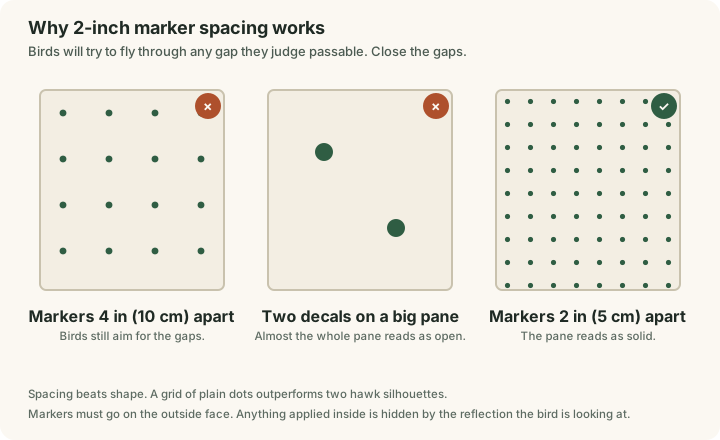
- Space the markers no more than about 2 inches (5 cm) apart. Birds attempt to fly through any gap that looks big enough, and most feeder birds will try a 3 inch (7.5 cm) hole.
- One hawk silhouette decal does nothing. It leaves the rest of the pane looking like open sky.
- Put feeders either closer than 3 feet (1 m) or farther than 30 feet (9 m) from glass. In between is where birds build up lethal speed.
Glass is one of the largest human-related causes of bird deaths in North America, killing birds in the hundreds of millions annually in the United States alone. Most of those deaths happen at ordinary houses and low buildings, not skyscrapers, which means a homeowner with a few windows is part of the problem and can be part of the fix.
Two rules cover nearly everything that works. Markers go on the outside of the glass, and they are spaced no more than about 2 inches (5 cm) apart. Birds do not see glass; they see the sky and trees reflected in it, and they will try to fly through any gap in a pattern that looks wide enough for their body.
This page covers why glass kills, why spacing is the whole ballgame, which treatments hold up, where feeders belong relative to windows, and what to do with a bird that has already hit.
Why birds fly into glass#
Birds have no concept of a transparent barrier. Daytime collisions come from two situations.
Reflection. A window mirroring trees, shrubs or open sky is indistinguishable from the real thing. This is the common case at homes, and it is worst on bright days, on glass with a dark interior, and on large panes facing vegetation.
See-through. Two windows in line, a glass corner, or a picture window with a doorway beyond it looks like a flight path to habitat on the other side. Glass railings, deck panels and greenhouse walls do the same.
Night migration adds a third: artificial light draws migrating birds into lit buildings, which is what "lights out" programs address in cities.
The birds that die are not careless individuals. Fast, low-flying woodland species take the worst of it, and a flush from a hawk or a cat sends a whole feeder flock at the glass at once.
The two numbers that matter
Markers on the outside, spaced no more than 2 inches (5 cm) apart. Get those right and almost any material works. Get them wrong and nothing does.
Why spacing is the whole answer#
A bird approaching a window is looking for a way through. Where a pattern leaves gaps, it aims at the gaps.
Older guidance used a 4 inch by 2 inch (10 cm by 5 cm) rule, with wider horizontal spacing than vertical. Current practice has tightened toward a uniform grid of about 2 inches (5 cm) in both directions, because small songbirds attempt openings smaller than most people assume. If in doubt, go tighter. There is no penalty for a denser pattern beyond how it looks.
Two things follow from this. First, a single decal fails, regardless of its shape, because it treats a few square inches of a pane and leaves the rest reflective. Second, coverage has to extend over the entire piece of glass, not just the middle.
Treatments that work, compared#
| Treatment | Cost | Effectiveness | Notes |
|---|---|---|---|
| External insect screen over the pane | Low to moderate | Very high | Breaks up reflection and cushions any impact; the best all-round option |
| Paracord or taut string curtain, cords about 4 in (10 cm) apart | Low | Very high | Vertical cords hung outside; birds will not fly between them |
| Dot pattern applied outside, 2 in (5 cm) grid | Low to moderate | High | Tape, film dots or paint markers; the reference standard |
| Patterned or fritted glass film on the exterior | Moderate | High | Long-lasting, tidy, needs careful application |
| Tempera paint or soap grid on the outside | Free to very low | High while it lasts | Wash-off tempera is ideal for problem windows; repaint after heavy rain |
| Exterior shades, awnings or shutters | Moderate to high | High when deployed | Removes direct sun and reflection entirely |
| Bird-safe glass with an etched pattern | High | Very high | For new builds and replacements |
| One or two hawk silhouettes | Low | None | Leaves the pane reflective |
| Interior decals or films | Low | Low | Hidden behind the exterior reflection |
| Ultraviolet-only decals | Moderate | Uncertain, mixed evidence | Depends on light angle and species |
| Sound devices, plastic owls, wind chimes | Low to moderate | None | Birds do not associate them with the glass |
Screens deserve special mention. If you already have exterior insect screens, leave them up year round on the problem windows. They do two jobs: the mesh kills the reflection, and if a bird still comes in, it hits a springy surface rather than a rigid one.
Finding your problem windows#
You do not need to treat every window in the house. Usually one or two are responsible for nearly all of the strikes.
- Go outside on a bright day and look at each window from where a bird would approach, standing 15 to 30 feet (4.5 to 9 m) back at bird height. If you see reflected trees or sky, that pane is a hazard.
- Look for see-through paths: aligned windows, glass corners, doors with glass beyond.
- Check the ground for evidence. Feather smudges on the glass, a scattering of down, or repeated small dents in the same spot are all signs. Many strikes leave no body, because injured birds fly on and die elsewhere or are taken by predators.
- Note which windows face the feeders and the bird bath.
Tempera paint costs almost nothing
Water-based tempera paint, applied to the outside with a sponge or a stencil in a 2 inch (5 cm) grid of dots, is the cheapest full-coverage treatment there is. It survives rain for weeks, comes off with a scrub, and lets you test a pattern before committing to film. Bar soap works the same way for a short-term fix.
Feeder distance: under 3 feet or over 30 feet#
Feeder placement changes strike rates dramatically, and the rule is counterintuitive.
Under 3 feet (1 m). A bird leaving a feeder that close cannot accelerate to a speed that causes serious injury before it reaches the glass. Window-mounted feeders and feeders on a short pole right against the house both fall in this band, and window feeders are among the safest setups available.
Over 30 feet (9 m). Far enough that the window is not part of the bird's escape route, and reflections are less likely to be mistaken for a continuous flight path.
The 3 to 30 foot (1 to 9 m) band is where birds build lethal speed. This is exactly the distance most people choose, because it is the comfortable viewing range. The full reasoning is in feeders and windows: the one foot / thirty foot rule, and it should be one of the first decisions in where to hang a bird feeder.
Placement is a supplement to treating the glass, not a replacement for it. A flushed flock scatters in every direction regardless of where the feeder sits.
Netting has to be done right
Loose netting hung near a window can entangle birds by the wing or leg. If you use bird netting, it must be small mesh, roughly 3/4 inch (2 cm), pulled taut on a frame that stands a few inches proud of the glass so a bird bounces off rather than getting caught. Slack netting draped over a window is a hazard, not a fix.
Strikes during a predator flush#
A large share of feeder-area collisions happen in the seconds after something scares the flock. A Cooper's hawk comes in low, thirty birds leave the feeder at once, and several fly straight into the reflection of the yard.
That is why treating glass matters more at a feeding station than anywhere else, and why the two go together with the cover recommendations in brush piles and cover and the ambush-proof spacing in cats and bird feeders. Escape cover about 10 feet (3 m) from the feeder gives startled birds somewhere to go that is not the house.
Night lighting and seasonal peaks#
Migration seasons, roughly spring and fall, produce spikes in collisions as unfamiliar birds pass through. Two easy measures help:
- Turn off or shield outdoor lights during migration nights, and close blinds on lit rooms. Artificial light disorients night migrants.
- Watch the fall window especially, when inexperienced young birds are moving. The wider seasonal context is in feeding birds during migration.
If a bird hits your window#
- Contain it. A ventilated cardboard box lined with paper towel, no wire cage. Wear gloves if you have them.
- Dark, warm and completely quiet. No food, no water, no checking every five minutes. Handling and noise add stress to a concussed bird.
- Wait one to two hours, then take the closed box outside, open it, and step well back.
- If it cannot fly, is holding a wing wrong, has a drooping head, or is still down after a couple of hours, call a licensed wildlife rehabilitator or your state wildlife agency. Head trauma and internal bleeding are common and are not things you can treat.
- Never give water by mouth or try to feed it. Both risk drowning the bird.
Then treat that window. A strike is information: the glass will do it again.
What to do this week#
- Identify your one or two worst windows by standing outside and looking for reflections at bird height.
- Treat them on the outside, at about 2 inch (5 cm) spacing, with screens, cords, dots or tempera paint. Anything at that spacing beats anything at a wider one.
- Move feeders and baths to under 3 feet (1 m) or beyond 30 feet (9 m) from glass.
- Add escape cover about 10 feet (3 m) from the feeder so flushed birds have a destination.
- Shield outdoor lighting during migration, and put a cardboard box and a towel somewhere you can reach quickly.
- Work through the rest of the yard-level measures in the bird-friendly yard checklist.
Frequently asked questions#
How far apart should window decals be to stop bird strikes?
No more than about 2 inches (5 cm) apart across the whole pane, in both directions. Birds will attempt to fly through any gap that looks passable, and small songbirds routinely try 3 inch (7.5 cm) openings. A few scattered decals leave most of the glass looking like clear sky, which is why they fail.
Do hawk silhouette stickers prevent window strikes?
No. A single silhouette does not read as a predator to a bird, and more importantly it leaves the rest of the window untreated and still reflective. The shape is irrelevant; what matters is covering the whole pane with a pattern spaced about 2 inches (5 cm) apart on the outside.
Should window treatments go on the inside or the outside of the glass?
The outside, almost always. Daytime strikes happen because the glass mirrors sky and vegetation, and a reflective surface hides anything behind it. Markers on the interior only work on very lightly reflective glass or when interior lights are strong, so treat the exterior surface as the default.
How far should a bird feeder be from a window?
Either under 3 feet (1 m) or over 30 feet (9 m). Very close means a startled bird cannot reach a dangerous speed before hitting the glass, and far away means the window is not part of the escape route. The distances in between are the ones that kill birds, especially when a hawk or cat causes a mass flush.
A bird hit my window and is stunned. What should I do?
Put it in a ventilated cardboard box lined with paper towel, in a dark, warm, quiet place, with no food or water, and leave it alone for an hour or two. Then take the box outside, open it, and step back. If the bird cannot fly, or is holding a wing oddly, or has been that way for more than a couple of hours, call a licensed wildlife rehabilitator, since head trauma and internal injuries are common.
Do ultraviolet decals work on windows?
The evidence is mixed and weaker than the marketing suggests. Some birds see well into the ultraviolet range, but the effect depends heavily on light conditions and viewing angle, and results in testing have been inconsistent. Visible markers spaced 2 inches (5 cm) apart on the outside are the reliable option.